Frequently Asked Questions
The most-asked questions about chemical elements.
What exactly is this 'franchise' about?
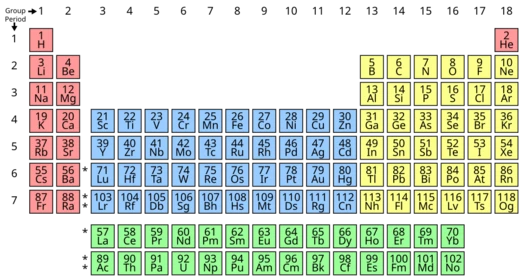
Chemical elements are the fundamental building blocks of all matter, each defined by a unique number of protons in its nucleus. Together they form the periodic table, a structured cast list of 118 confirmed characters arranged by atomic number and chemical behavior.
Who are the main characters everyone knows?
Hydrogen, helium, carbon, oxygen, and iron are the most abundant and widely recognized elements in the universe. Carbon and oxygen in particular drive nearly all known biochemistry, making them the protagonists of life on Earth.
Where should a newcomer start reading?
Begin with the first period (hydrogen through helium) and the second period (lithium through neon) to grasp the basic patterns of electron shells. From there, work left-to-right across a period and top-to-bottom down a group to see how properties repeat.
How many elements are in the full cast?
As of current IUPAC recognition, 118 elements have been confirmed, from hydrogen (Z=1) to oganesson (Z=118). Elements 93 and above are all synthetic, meaning they exist only in laboratory settings.
What's the underlying story structure that organizes everything?
The periodic law arranges elements so that those with similar valence-electron configurations fall into the same vertical group, producing predictable patterns in reactivity, ionization energy, and atomic radius. This repetition every period is what gives the table its familiar grid shape.
What are the main factions or teams?
Elements are broadly sorted into metals, metalloids, and nonmetals, with further sub-groups like the alkali metals, halogens, and noble gases. Each group shares a common outer-shell electron count, which dictates how its members bond and react with others.
What's the origin story for these characters?
Hydrogen and helium were forged in the first minutes after the Big Bang, while elements up to iron were cooked inside living stars through nuclear fusion. Heavier elements like gold, uranium, and lead were blasted into existence during supernova explosions and neutron-star mergers.
Which elements are the most dangerous or reactive?
Alkali metals such as cesium and francium react explosively with water, while highly radioactive isotopes like polonium-210 and astatine are lethal in microscopic quantities. The superheavy synthetic elements at the far right of the table also decay within milliseconds to seconds.
What are the most recent new characters added?
Nihonium, moscovium, tennessine, and oganesson (elements 113, 115, 117, and 118) were officially confirmed in 2016, completing the seventh period. They are all produced one atom at a time in particle accelerators and decay almost instantly.
Is the series still ongoing, or is it finished?
Theoretical models suggest elements beyond oganesson could exist, but each new synthetic element requires increasingly powerful colliders and becomes harder to confirm. Whether a superheavy island of stability around Z≈120–126 actually exists remains one of the open questions in nuclear physics.